One of the challenges of transitioning to high school and post-graduate years is developing the independence. It doesn’t happen overnight, and students need support as they move away from parent-led schooling into independent-schooling. Here are some study tips to help champion your student!
Why work on independence in the school day?
Frees mom up to work with younger siblings or provide one-on-one instruction as needed
Boosts problem-solving skills and allows them to develop their own ‘groove’
Hands over the responsibility for both setting a schedule and completing the work
Maintain communication.
This is not the time to just let go of the strings and see what happens. Check in with your kids on a regular basis, be that every few hours, once a day, or once a week (this will depend on the kid and what’s going on at any given time). Review what has been done and what is coming up next. This will help them stay focused and on track, plus it will give both of you a structure to work around.
By outsourcing courses, students also learn to be responsible to someone other than mom and dad, but still have parental support and oversight. At Sparks Academy, for example, students are provided a schedule and taught in teacher-led and teacher-graded courses, but parents are sent a quarterly newsletter and progress report as a reminder to check in regularly.
If your student isn’t sure about their learning style, have them take this free quiz. By learning and playing toward learning style strengths, students are more likely to maximize their study time and improve their academic performance. This might include working with music or wearing noise-cancelling headphones, working in a brightly lit or dim area, working with others or working alone. Additionally, you’ll want a comfortable chair or desk, adequate supplies, and a place to spread out books and resources.
Unless being used specifically for academic purposes, electronics should be put away during school time to limit distractions. This is particularly true for students with ADHD or other special needs. You might even go as far as to use a scheduler to block social media sites during school time, if needed. By setting the right tone, your student will have a better chance of staying focused on the tasks at hand.
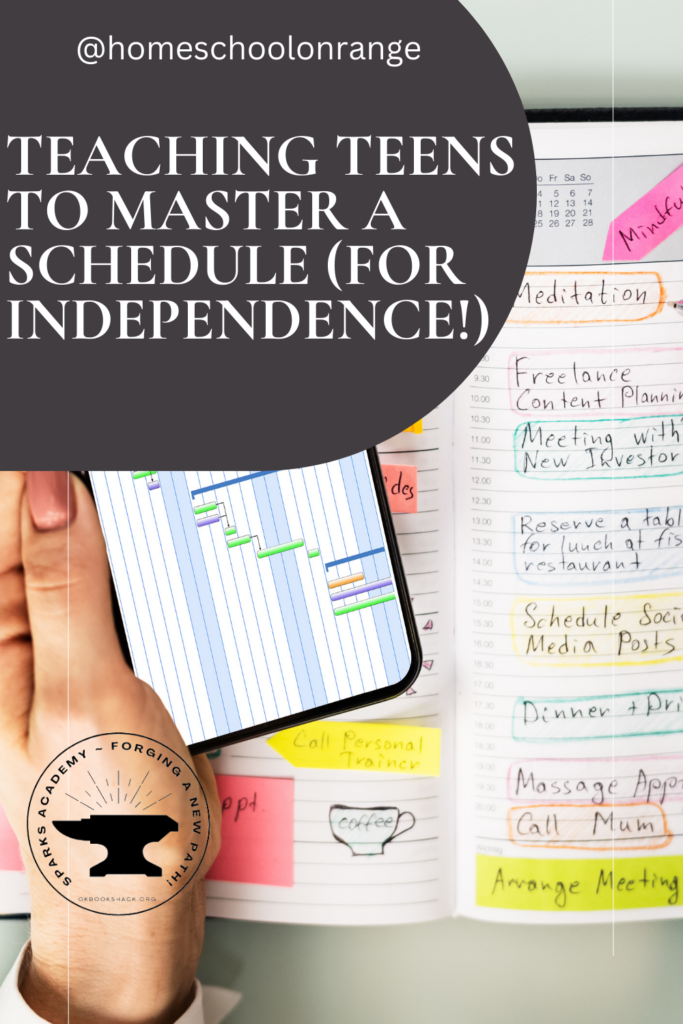
Probably the most important skill your teen will learn is time management, which translates across all aspects of life, not just academics. Students need to learn to prioritize tasks (we call it triage in our house) and set the pace for completing those tasks. Rather than constantly telling them what to be doing when, allow them to take a set of tasks, prioritize them, and complete them in their own time (with a set deadline).
Be sure to enforce the deadlines, too, even though there will be times when they don’t meet them and need some sort of natural consequence. When this happens, it’s a good time to work on ‘working backward,’ taking a large task, breaking it into smaller tasks, and scheduling each in order to meet a deadline. Whether in college or on the job, there are always deadlines to be met and someone to answer to for our responsibilities…and by allowing them to start developing those skills now, you’re giving them a leg up.
Set Manageable Goals.
Checklists are wonders. They can really keep a person on track, be that mom trying to accomplish all the things or students trying to remember assignments. By learning to use planners and checklists in high school, students can find a system of organization that works best for them and will set them up for better success post-graduation. There are both physical and digital planners, and there is no right or wrong option…only the one that is right for them! As a bonus, planners (particularly physical ones) can be used as documentation of academic assignments and performance. Just toss it aside at the end of each semester or year to have on-hand if needed.
Note-taking used to be much more common than it is now, and even when teens are taking notes these days, it tends to be digitally. However, there is so much to be said for learning to take hand-written notes. Using old-fashioned pen and paper engages several senses and an area of the brain that facilitates learning. Follow these four rules for note-taking, and you should see marked improvement in your academics: be prepared, write neatly, stay organized, and write down questions.
There are as many different forms of note-taking as there are students. You’ll need to find what works best for your learning. Visit this post on Note-Taking for Teens to learn about several different styles and to learn more about teaching the art of taking notes.
Look for more in-depth discussion of this topic and more in Through the Door: Homeschool to College Success!This book & worktext set will help you and your high school student breeze through the steps of college and scholarship applications, as well as brushing up on study habits and life skills. The worktext includes activities, worksheets, and planning pages, and accompanies the book.
A lot of folks seem to be intimidated by the idea of homeschooling their teens through high school and graduation. When we first began homeschooling, we met some pushback, but persisted and even fifteen years later were still got asked occasionally if they kids were going to high school. While one son did do dual enrollment, the right fit for him, and another did votech classes at the local community college, again the right fit, both boys also took several classes at home as well. They graduated from homeschool.
If you’re planning to graduate a teen from homeschool, there are a few things you’ll want to plan for first.
Know Your State Law
Be sure that you know the homeschooling laws for your state so that there are no surprises at the end of the journey! Some states, such as New York, North Dakota, and Pennsylvania, have very specific rules governing how a homeschooler can get a diploma, while most other states simply offer guidelines. Check HSLDA to find your state’s specific laws.
If a college or program requires accreditation, know that your homeschool and curriculum are not accredited. Most colleges, however, will accept a homeschool diploma if your students meets the entrance requirements, and it’s worth noting that not all public schools maintain their accreditation either.
Have an Idea of Your Student’s Plan
Start with the end in sight. Choose courses and a high school plan based on what the student plans to do post-graduation, be that a college major or setting off on a career path. If college is the plan, check their admissions requirements and plan accordingly. If career is the goal, you’ll still need to meet basic requirements for graduation, but choose electives based on that future path.
Generally, most students should be taking four years of language arts, three years of science, three years of history, three years of math, two years of a foreign language, and several electives to total approximately 26 credits. Some states will have additional requirements, such as state history or health and physical education, so be sure to check those laws and your state department of education website.
If your student isn’t sure of the post-graduation plan, homeschool with college as the end goal. It is easier to go down a career path with a college-prep education than it is to apply for college with only career-prep courses.
Start keeping the high school transcript in ninth grade, and eighth grade if they are taking advanced classes. It’s not only colleges who will ask for it, but many first-time employers and scholarship providers will as well. Be sure to transfer grades from any online programs or outside grade sources to the transcript and keep any certificates your student earns as well. In Through the Door, you’ll find transcript templates and instructions for putting together each section of this important document.
Standardized testing is another important part of record-keeping, especially if college is the future goal. Most students will need to take either the ACT or SAT entrance exam. College-bound students might take the exam more than once, both to get a superscore (where the highest scores from each subsection are combined from across all testing experiences) and for the test-retest effect. However, even if your student isn’t college-bound, it can be a good idea to take the exam simply to back up the grades you have given in homeschool, just in case you are ever questioned about them.
Stay in the Loop
Make a connection with the local high school counselor and learn where they post information for students. Get on that communication thread and stay in the loop. While traditionally-schooled students are often inundated with information about when testing dates are, what career and college fairs are on the horizon, or other opportunities for teens, homeschoolers aren’t usually privy to that information…and you want to be. This can also be a good place to learn about local scholarship programs or job shadowing events.
Plan a Graduation
After you’ve kept the coursework, met the requirements, and printed the transcripts, it’s time to issue a diploma. Many families choose to join a local group for a formal graduation ceremony or host their own at home.
If you want to host a ceremony at home, it can be as simple as playing the commencement song, saying some words, looking over pictures from kindergarten through graduation, and handing out a diploma. Some families host a reception, similar to a wedding reception, afterward, with food and fun.
Admittedly, rather than hosting or joining a ceremony, we provided our sons with graduation experiences. England, Germany, South Africa…these travel opportunities provide a lifetime of memories and new cultural experiences. Travel is important to mom and dad, and we roadschooled across the country with the kids when they were younger, so it was a natural progression to spend that money on an overseas trip of their choice, and they preferred it over a big party event. Again, the beauty of homeschooling is that each family can make a choice that is right for them!
Seasoned homeschoolers with a few graduates under their belts can easily remember the anxiety of homeschooling that oldest child, making sure to meet all of the requirements and hoping that it was the right move for their future. We all want what is best for our kids, and by being informed, you can confidently proceed toward a successful homeschool graduation.
A gap year is a period of time, typically a year, between years of formal education. Some choose to take a gap year between high school and college, while others might take a break during the college years. During this time, students may travel, volunteer, or work, as they gain life experience and explore the world.
The concept of a gap year is not new; it goes back centuries to the European elites who would finish their schooling and then take a grand world tour, visiting a variety of places, learning about different cultures and languages, and making connections. It fell out of vogue during the Napoleonic Wars, but came back into play in the 20th century. During the 1960s, it became popular in America with the baby boomers. Their theory was that by travelling and learning about other cultures, they could foster world peace.
The gap year often provides flexibility to explore special interests, travel, do an exchange program, or volunteer. For students who may not have the same financial resources, it is also an opportunity to explore career options, work to earn money for college expenses, take a rest from academics, and explore special interests or take a trip. The common thread among nearly all gap years is that they are a time of self-discovery when students can gain practical life experiences that help them make those important future decisions.
Should you take a gap year?
Students looking for more independence will have an opportunity to make their own decisions, manage their own finances and schedule, and cultivate peer connections.
Students looking for cultural experiences and a broader worldview can travel, volunteer with travelling organizations, interact with other cultures, and face new life experiences.
Students who are undecided about their next steps can take some time to explore career opportunities, gain life experiences, explore various fields and interests, and make an informed decision about their future academic or career tracks.
Students looking to cover college expenses without major loans can mitigate those expenses by continuing to live at home and working full time. While this is the least “fun” of the gap year options, it still provides an opportunity for self-reflection, gaining life experiences, and laying a strong foundation for the future.
There are some drawbacks, however, to taking a gap year. Some students may feel left out, as their peers head into college and they do not. Without adequate planning for both the gap year and what happens afterward, students might stall or spend the entire year unwisely, not gaining the experiences they wanted. If there is a lot of travelling involved, there might be a large cost for the year. Finally, after taking a year off, it can be difficult to get back into the academic groove to finish out college, and students may not have the same resources they had (to assist with college planning) in high school.
Gap Year Pros and Cons
Pros Work Experiences Life Skills Cultural Experiences Self-Reflection & Growth Save / Earn Money Explore Interests Rest and Recharge
Cons Feeling Left Out / FOMO Stalling Cost Lack of Structure Difficult to Get Back Potential Lost Time Restricted Resources
One additional pro of taking a gap year is that students will have fodder for all those college and scholarship application essays! However, it is of the utmost importance to spend time responsibly planning the gap year. Map out experiences, break down the months into an ‘experience calendar,’ and research different gap year programs that provide travel, volunteering, and other life experiences. (Caveat – these can be expensive.)
Before heading into a gap year, remember to get copies of transcripts, letters of recommendation, references, and any other academic resources from the school that will be needed during the transition from gap year to a return to academics. If the plan is to return to college, remember to keep that end goal in sight, too. Bon voyage!